Western Oregon senior Sara Tucholsky had never hit a home run in her career. Central Washington senior Mallory Holtman was already her school's career leader in them. But when a twist of fate and a torn knee ligament brought them face to face with each other and face to face with the end of their playing days, they combined on a home run trot that celebrated the collective human spirit far more than individual athletic achievement.
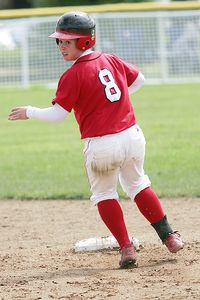
Stephen Katin/WOU
Sara Tucholsky got a lift from the opposition in scoring her first homer.
Both schools compete as Division II softball programs in the Great Northwest Athletic Conference. Neither has ever reached the NCAA tournament at the Division II level. But when they arrived for Saturday's conference doubleheader at Central Washington's 300-seat stadium in Ellensburg, a small town 100 miles and a mountain range removed from Seattle, the hosts resided one game behind the visitors at the top of the conference standings. As was the case at dozens of other diamonds across the map, two largely anonymous groups prepared to play the most meaningful games of their seasons.
It was a typical Saturday of softball in April, right down to a few overzealous fans heckling an easy target, the diminutive Tucholsky, when she came to the plate in the top of the second inning of the second game with two runners on base and the game still scoreless after Western Oregon's 8-1 win in the first game of the afternoon.
"I just remember trying to block them out," Tucholsky said of the hecklers. "The first pitch I took, it was a strike. And then I really don't remember where the home run pitch was at all; [I] just remember hitting it, and I knew it was out."
A part-time starter in the outfield throughout her four years, Tucholsky had been caught in a numbers game this season on a deep roster that entered the weekend hitting better than .280 and having won nine games in a row. Prior to the pitch she sent over the center-field fence, she had just three hits in 34 at-bats this season. And in that respect, her hitting heroics would have made for a pleasing, if familiar, story line on their own: an unsung player steps up in one of her final games and lifts her team's postseason chances.
But it was what happened after an overly excited Tucholsky missed first base on her home run trot and reversed direction to tag the bag that proved unforgettable.
"Sara is small -- she's like 5-2, really tiny," Western Oregon coach Pam Knox said. "So you would never think that she would hit a home run. The score was 0-0, and Sara hit a shot over center field. And I'm coaching third and I'm high-fiving the other two runners that came by -- then all of a sudden, I look up, and I'm like, 'Where's Sara?' And I look over, and she's in a heap beyond first base."
While she was doubling back to tag first base, Tucholsky's right knee gave out. The two runners who had been on base already had crossed home plate, leaving her the only offensive player on the field of play, even as she lay crumpled in the dirt a few feet from first base and a long way from home plate. First-base coach Shannon Prochaska -- Tucholsky's teammate for three seasons and the only voice she later remembered hearing in the ensuing conversation -- checked to see whether she could crawl back to the base under her own power.
Rule clarification
As one of the umpires involved in the game between Central Washington and Western Oregon confirmed in an e-mail to ESPN.com, the rule in question was misinterpreted on the field after Tucholsky's injury and later clarified by the NCAA.
According to page 105, rule 8.5.3.2 of the NCAA softball rule book, "If an injury to a batter-runner or runner prevents her from proceeding to an awarded base, the ball is dead and the substitution can be made. The substitute must legally touch all awarded or missed bases not previously touched."
-- Graham Hays
As Knox explained, "It went through my mind, I thought, 'If I touch her, she's going to kill me.' It's her only home run in four years. I didn't want to take that from her, but at the same time, I was worried about her."
Umpires confirmed that the only option available under the rules was to replace Tucholsky at first base with a pinch runner and have the hit recorded as a two-run single instead of a three-run home run. Any assistance from coaches or trainers while she was an active runner would result in an out. So without any choice, Knox prepared to make the substitution, taking both the run and the memory from Tucholsky.
"And right then," Knox said, "I heard, 'Excuse me, would it be OK if we carried her around and she touched each bag?'"
The voice belonged to Holtman, a four-year starter who owns just about every major offensive record there is to claim in Central Washington's record book. She also is staring down a pair of knee surgeries as soon as the season ends. Her knees ache after every game, but having already used a redshirt season earlier in her career, and ready to move on to graduate school and coaching at Central, she put the operations on hold so as to avoid missing any of her final season. Now, with her own opportunity for a first postseason appearance very much hinging on the outcome of the game -- her final game at home -- she stepped up to help a player she knew only as an opponent for four years.
"Honestly, it's one of those things that I hope anyone would do it for me," Holtman said. "She hit the ball over her fence. She's a senior; it's her last year. … I don't know, it's just one of those things I guess that maybe because compared to everyone on the field at the time, I had been playing longer and knew we could touch her, it was my idea first. But I think anyone who knew that we could touch her would have offered to do it, just because it's the right thing to do. She was obviously in agony."
Holtman and shortstop Liz Wallace lifted Tucholsky off the ground and supported her weight between them as they began a slow trip around the bases, stopping at each one so Tucholsky's left foot could secure her passage onward. Even with Tucholsky feeling the pain of what trainers subsequently came to believe was a torn ACL (she was scheduled for tests to confirm the injury on Monday), the surreal quality of perhaps the longest and most crowded home run trot in the game's history hit all three players.
"We all started to laugh at one point, I think when we touched the first base," Holtman said. "I don't know what it looked like to observers, but it was kind of funny because Liz and I were carrying her on both sides and we'd get to a base and gently, barely tap her left foot, and we'd all of a sudden start to get the giggles a little bit."
Accompanied by a standing ovation from the fans, they finally reached home plate and passed the home run hitter into the arms of her own teammates.
Then Holtman and Wallace returned to their positions and tried to win the game.
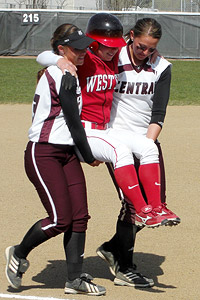
Blake Wolf
Sara Tucholsky got a lift from Central Washington's Liz Wallace, left, and Mallory Holtman.
Hollywood would have a difficult time deciding how such a script should end, whether to leave Tucholsky's home run as the decisive blow or reward the selfless actions of her opponents. Reality has less room for such philosophical quandaries. Central Washington did rally for two runs in the bottom of the second -- runs that might have tied the game had Knox been forced to replace Tucholsky -- but Western Oregon held on for a 4-2 win.
But unlike a movie, the credits didn't roll after the final out, and the story that continues has little to do with those final scores.
"It kept everything in perspective and the fact that we're never bigger than the game," Knox said of the experience. "It was such a lesson that we learned -- that it's not all about winning. And we forget that, because as coaches, we're always trying to get to the top. We forget that. But I will never, ever forget this moment. It's changed me, and I'm sure it's changed my players."
For her part, Holtman seems not altogether sure what all the fuss is about. She seems to genuinely believe that any player in her position on any field on any day would have done the same thing. Which helps explains why it did happen on that day and on that field.
And she appreciates the knowledge that while the results of Saturday's game and her senior season soon will fade into the dust and depth of old media guides and Internet archives, the story of what happened in her final game at home will live on far longer.
"I think that happening on Senior Day, it showed the character of our team," Holtman said. "Because granted I thought of it, but everyone else would have done it. It's something people will talk about for Senior Day. They won't talk about who got hits and what happened and who won; they'll talk about that. And it's kind of a nice way to go out, because it shows what our program is about and the kind of people we have here."
Graham Hays is a regular contributor to ESPN.com. E-mail him at Graham.Hays@espn3.com.
Original here


