Followers

Monday, June 9, 2008

Ivanovic, the New No. 1, Is Also Tops in Paris

Pascal Rossignol/Reuters

Ana Ivanovic won her first Grand Slam championship by defeating Dinara Safina 6-4, 6-3.

PARIS — It was time for another French Open women’s final, and although the four-time winner Justine Henin was still on the grounds, she was no longer on the clay.

With Henin retired and watching from the front row, it was time for a new Grand Slam champion, and it turned out to be Ana Ivanovic, the same young, elegant Serb who had let her nerves get the best of her against Henin in last year’s flop of a final.

Ivanovic is a better, fitter, more composed contender now, and on Saturday, she filled the void at the top of the clay-court game in style by defeating 13th-seeded Dinara Safina of Russia, 6-4, 6-3.

“Obviously, the nerves were still there, but that’s normal,” Ivanovic said. “Last year’s final was a great learning experience for me.”

Ivanovic, 20, was already guaranteed to become No. 1 in the women’s rankings Monday after beating her Serbian compatriot Jelena Jankovic in the semifinals. Now, she has her first Grand Slam singles title along with the top spot, and Serbia, once an international pariah, has its latest reason to organize a celebration in Belgrade.

In January, Novak Djokovic became the first Serbian man to win a major singles title, at the Australian Open. “Going into today’s final, I thought of it,” Ivanovic said. “I said: ‘Come on. He could do it. I could do it, too.’ So it’s something that for sure motivates, and I hope also many young kids will get inspired from us.”

Ivanovic is a towering fast talker with a trump card of a forehand. Although she has a friendly, upbeat disposition — unlike some of the harder-edged women’s stars over the years — she had to overcome major adversity to become a major champion.

Ivanovic was part of the remarkable Serbian tennis generation that developed despite the internal conflicts linked to the breakup of the former Yugoslavia. At 13, she was reduced to training on a makeshift court in Belgrade that was in the bottom of an empty swimming pool.

Later, like Jankovic and Djokovic, Ivanovic became an expatriate as a teenager to take her game to the next level. Ivanovic, not considered a can’t-miss junior, based herself in Roger Federer’s home city, Basel, Switzerland, after Dan Holzmann, an Israeli-born Swiss businessman, agreed to finance her career at a time when money and opportunity were drying up.

“I met the family, and 24 hours later, I made the decision to help,” said Holzmann, who added, “I have a lot of people working with me and colleagues and offices, but to hear it from a 15-year-old girl, so committed and so clear, that she wants to be No. 1, I was really impressed.”

With Holzmann’s support, about $10,000 to $20,000 a month in the early years, the family hired the veteran coach Eric Van Harpen, who had worked with the Spanish stars Conchita Martínez and Arantxa Sánchez Vicario.

Ivanovic made her first major impression at 17, when she upset the French star Amélie Mauresmo here and reached the 2005 quarterfinals. But questionable fitness and a tendency to become tight under big-match pressure held her back until last year, when she rolled to the final before winning just three games against Henin.

She failed to control her emotions again in this year’s Australian Open final against Maria Sharapova.

“I had a few sleepless nights after that, honestly,” Ivanovic said. “Part of me was already thinking about possibly holding the trophy, you know. So this time, I really tried to change that and don’t think about that at all and just focus on my game. There were some moments where this thought would still come up, but I managed to control it much better.”

This time, the Russian on the other side of the net was not an established winner accustomed to the pomp and circumstance of a Grand Slam final. Safina, the 22-year-old sister of the former men’s No. 1 Marat Safin, had never been past the quarterfinals of a major tournament.

The differences Saturday were Ivanovic’s forehand, slightly better court coverage and ability to attack Safina’s second serve. Safina still kept it interesting, however, rallying from a 1-4 deficit to 4-4 in the opening set before Ivanovic closed it out. In the second, after losing her serve again early, Safina stayed close by holding serve in a marathon seventh game. But the effort seemed to leave her drained, and she ended up winning just one point in the final two games.

Ivanovic was soon climbing into the stands to hug friends and her parents, Dragana and Miroslava. Back on the clay, she received the Coupe Suzanne Lenglen from Henin, who won it the last three years before retiring unexpectedly last month, citing a loss of motivation.

“I really wanted to try and face her again here and hopefully be better,” Ivanovic said. “But still it was great to see her there and, at the end, when she handed me the trophy, she was really nice, and she said, ‘You know you deserve it, so now it’s yours.’ ”

Holzmann, his investment long since repaid, was among those tearing up in the stands. “Normally, I’m not a very emotional guy,” he said. “But I know what they went through. It’s tough to have a daughter, no money, traveling.”

He added, “I don’t know if I would do that with my kid, but they did it and were committed, so of course I was emotional about them being emotional.”

It was the first French Open singles title for a Serb since the Serbian-born Monica Seles won here in 1992 while representing Yugoslavia.

Seles was Ivanovic’s idol, the big-hitting reason she took up the game.

“I had a chance to meet her and have dinner with her last year in New York, and it was very nice,” Ivanovic said. “I was sitting there with her and I kind of didn’t know what to say. I was like: How can I ask her? I mean she’s such a great champion, and who am I?”

The internal dialogue will presumably be different the next time they meet. Ivanovic is, after all, a Grand Slam champion herself now.

Original here

Top 10 moments in Celtics-Lakers postseason history

With 10 NBA Finals series under their belts, the Boston Celtics and Los Angeles Lakers have had plenty of historic moments. Below is a list compiled by ESPN research of the top 10 moments in Finals history between the Celtics and the Lakers.

Magic Johnson

Getty Images

Magic Johnson clutches his third Finals MVP award in 1987.

1. 1987 NBA Finals, Game 4 (June 9)
Trailing by one point, the Lakers put the ball and the game in the hands of Magic Johnson. Like he had so many times before, he delivered the game-winning blow, a running hook shot in the lane.

The 107-106 victory over the Celtics gave the Lakers a 3-1 edge in the series, which they would eventually win in six games. Magic's performance led him to winning his third NBA Finals MVP.

2. 1962 NBA Finals, Game 7 (April 18)
Frank Selvy had a chance to end the game for the Lakers in regulation, but his miss forced the game into overtime, when the Celtics, behind Bill Russell's 30 points and 40 rebounds, would go on to win 110-107 and win Boston's fifth NBA title.

3. 1962 NBA Finals, Game 5 (April 14)
Elgin Baylor scored a Finals-record 61 points for the Lakers, who were making their first title-game appearance. Baylor also added 22 rebounds in leading the Lakers to a 126-121 victory and a 3-2 series lead. However, Boston would go on to win the final two games and win the title.

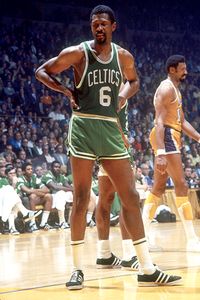
Bill Russell

George Long/WireImage

Russell and Wilt had their battles but Russell's 11 rings do the final talking.

4. 1969 NBA Finals, Game 7 (May 5)
In what turned out to be Russell's final game, the Celtics saw a 17-point fourth-quarter lead almost disappear. Up only one point, Don Nelson put up a shot the bounded off the back of the rim and dropped into the net to keep the Celtics up for good.

Boston went on to win the game 108-106 and send Russell off with his unprecedented 11th title.

5. 1984 NBA Finals, Game 2 (May 31)
Trailing 1-0 after dropping Game 1 at home, the Celtics found themselves trailing Game 2 by two points with only 18 seconds left.

In jeopardy of losing the first two games of the series at home, Gerald Henderson intercepted a James Worthy pass and scored a game-tying layup. The Celtics won the game in overtime 124-121 and the series in seven games.

6. 1962 NBA Finals, Game 3 (April 10)
The logo made his presence felt in a tight Game 3 matchup. In a game tied at 115, Jerry West stole an inbounds pass intended for Bob Cousy with four seconds left in regulation and beat the clock for a game-winning layup.

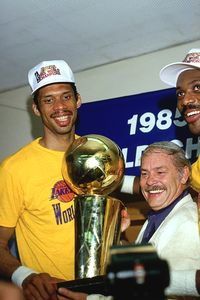
Kareem Adul-Jabbar

Andrew D. Bernstein/Getty Images

Kareem led the Lakers in 1985 over the Celtics for the first time in Finals history.

7. 1985 NBA Finals, Game 6 (June 9)
After receiving most of the blame for the Lakers' 148-114 loss in Game 1, Kareem Abdul-Jabbar went on to carry the Lakers the rest of the series. His 29-point performance in the series-clinching 111-100 win at Boston in Game 6 helped him become the oldest Finals MVP in NBA history and give the Lakers their first Finals series win over Boston after eight previous failed attempts.

8. 1984 NBA Finals, Game 4 (June 6)
This game will always be remembered as the game in which Kevin McHale sent a message to the Lakers by clotheslining Kurt Rambis to the ground on a breakaway layup. The message seemed to have worked as the Lakers went on to make several key mistakes in blowing a five-point lead with less than a minute to go.

The Celtics won the game 129-125 in overtime thanks to a Larry Bird game-clinching shot over Magic Johnson.

9. 1969 NBA Finals, Game 4 (April 29)
This game's importance was signified by the real-life version of the Hoosiers "picket fence" play. Sam Jones hit the game-winning shot to give the Celtics an 89-88 victory. The win tied the series at two against the heavily favored Lakers and set up one of the greatest upsets in Finals history.

10. 1985 NBA Finals, Game 4 (June 5)
Dennis Johnson's 20-foot jumper with one second left gave the Celtics a two-point victory over the Lakers in the Forum. The 107-105 victory tied the series 2-2. However, it would be Boston's final celebration -- the Celtics dropped the next two to lose the series in six games.

Rankings by Peter Newmann of ESPN

Original here

Saturday, June 7, 2008

Ex-Steel Curtain DE Dwight White dead at 58

"Dwight refused to be denied, as was evidenced when he walked out of the hospital with pneumonia to play in Super Bowl IX and had an outstanding game," Steelers owner Dan Rooney said of the passing of Dwight White, right.
AP file photo
"Dwight refused to be denied, as was evidenced when he walked out of the hospital with pneumonia to play in Super Bowl IX and had an outstanding game," Steelers owner Dan Rooney said of the passing of Dwight White, right.

PITTSBURGH (AP) — Dwight White, the Steel Curtain defensive end known as "Mad Dog" who helped lead the Pittsburgh Steelers to four Super Bowl titles in the 1970s, died Friday. He was 58.

The Steelers said White died at a Pittsburgh hospital. The cause was not disclosed. The team said White was released from the hospital after having back surgery, but then was readmitted with complications.

White is the second member of the original four-man Steel Curtain to die this year. Defensive tackle Ernie Holmes died Jan. 17 in a car accident in Texas.

White, a two-time Pro Bowl player, was chosen as one of the 33 members of the Steelers' 75th anniversary all-time team last season.

White was best known for climbing out of a hospital bed to play in the Steelers' first Super Bowl victory, 16-6 over the Minnesota Vikings in 1975. White lost 18 pounds after being diagnosed with pneumonia and a lung infection, yet played nearly the entire game.

White made three tackles for no yards as the Vikings ran seven of their first eight running plays his way and went on to finish with only 17 yards rushing on 21 attempts. White also accounted for the only points of the first half when he sacked Fran Tarkenton in the end zone for a safety.

White, a former player at East Texas State (now Texas A&M-Commerce), gained his nickname because of his intensity. He often said that playing on the defensive line was like having "a dog's life."

Steelers chairman Dan Rooney said that inner drive was the reason the 6-foot-4, 250-pounder could play so well only hours after being hospitalized.

"He played with a relentlessness that led us to four Super Bowl titles in the 1970s," Rooney said in a statement. "Dwight refused to be denied, as was evidenced when he walked out of the hospital with pneumonia to play in Super Bowl IX and had an outstanding game. Dwight will be remembered by those who knew him even more for being a wonderful and caring person."

Rooney's son, Steelers president Art Rooney II, said the organization "lost an important member."

"He always seemed to rise to the occasion when it counted most and added an element of toughness that was synonymous with our teams of the 1970s," Rooney II said.

White's death follows a trend in which former Steelers players have died at an uncommon rate. At least 38 former Steelers players have died since 2000, with 17 of them 59 or younger, as was White.

According to a Los Angeles Times survey in 2006, one-fifth of the former NFL players from the 1970s and 1980s who died through that year were former Steelers.

White was a fourth-round draft pick in 1971 after being a first-team All-Lone Star Conference player and team captain at East Texas State as a senior.

White made his first Pro Bowl in 1972, playing on a Steelers defensive line that also featured Hall of Famer Mean Joe Greene and defensive end L.C. Greenwood.

White repeated as a Pro Bowl selection in 1973 and his 46 sacks from 1971-80 are the seventh most in Steelers history. He had 33½ sacks from 1972-75, with three in the Steelers' 21-17 victory over the Dallas Cowboys in the January 1976 Super Bowl.

White was chosen by The Associated Press as a first team All-AFC player in 1973.

White retired after the 1980 season — one of the first players from the Steelers' Super Bowl teams to do so — and became a prominent stock broker in Pittsburgh and one of the most successful former Steelers in the business world.

Most recently, he was senior managing director of public finance for Mesirow Financial in Pittsburgh. Before that, he was a partner and principal operator of the Pittsburgh office of W.R. Lazard & Co., plus a company board member, and worked for investment firms Balche-Halsey and Daniels & Bell.

"Let's just say, like Yogi Bear used to say, I'm smarter than the average bear," White told Pittsburgh author Jim O'Brien in 1991. In the same interview, he said his one vice was he smoked too much.

White, the oldest of three children who grew up in Hampton, Va., and Dallas, also was involved in numerous community events and charity activities.

"He had a special gift that enabled him to liven up any room that he entered," Rooney II said.

White also was chairman of the Pennsylvania Governor's Council on Physical Fitness and Sports.

"His NFL nickname, Mad Dog, belied the fact that he was a true gentleman and an accomplished business leader," Gov. Ed Rendell said in a statement. "After retiring from football, he entered the financial services industry with the same tenacity and determination he showed on the football field."

Funeral services are scheduled for Wednesday in Pittsburgh.

Copyright 2008 The Associated Press. All rights reserved. This material may not be published, broadcast, rewritten or redistributed.

Original here