Followers

Friday, August 1, 2008

Ramirez traded to Dodgers in three-way deal

Slugger Manny Ramirez's stormy relationship with the Boston Red Sox is over.

Ramirez has been traded to the Los Angeles Dodgers. The Red Sox will pay the remaining $7 million of Ramirez's contract owed for this season, ESPN.com's Peter Gammons reported.

"When a player like Manny becomes available, I don't think there's a manager in baseball who wouldn't say they're interested," said Dodgers manager Joe Torre, whose Yankees teams went toe-to-toe with Ramirez for years. "It was something that happened very quickly, obviously."

Outfielder Jason Bay is going to Boston and the Pittsburgh Pirates get four minor leaguers as part of the three-way deal.

Third baseman Andy LaRoche and right-handed pitcher Bryan Morris will go to the Pirates from the Dodgers. Outfielder Brandon Moss and right-handed pitcher Craig Hansen will leave the Red Sox organization for Pittsburgh.

Wednesday's remarks by Ramirez, who has been involved in trade rumors the past few years, might have been the final straw for the Red Sox.

"The Red Sox don't deserve a player like me," Ramirez told ESPNdeportes.com. "During my years here, I've seen how they [the Red Sox] have mistreated other great players when they didn't want them to try to turn the fans against them.

"The Red Sox did the same with guys like Nomar Garciaparra and Pedro Martinez, and now they do the same with me. Their goal is to paint me as the bad guy. I love Boston fans, but the Red Sox don't deserve me. I'm not talking about money. Mental peace has no price, and I don't have peace here."

Dodgers infielder Garciaparra, who played for the Red Sox from 1996-2004, said he's always had the utmost respect for Ramirez.

"It's nice to see we've done something like this, to make a push for the next two months," Garciaparra said. "I think he'll be just fine. Manny is really a simple person. He works extremely hard. He just wants to play baseball and go home and be with his family. How can you not respect and love a guy like that?"

Ramirez, the MVP of the 2004 World Series, remains one of baseball's best hitters and has enjoyed plenty of big moments in October. But his relationship with the Red Sox soured -- again -- in recent months, prompting the All-Star outfielder to agree to the deal.

The Dodgers began the day one game behind first-place Arizona in the NL West, and were seeking a big bat. Boston, in the middle of the AL East race and chasing a second straight World Series title, wanted a productive hitter in return and got that in Bay.

At 29, Bay is a two-time All-Star and was hitting .282 with 22 home runs and 64 RBIs. Tampa Bay pursued Bay before he wound up with the Red Sox, who trail the first-place Rays by three games in the AL East.

Even before landing the enigmatic Ramirez, Los Angeles had a crowded outfield. Torre has been juggling Matt Kemp, Andre Ethier, Andruw Jones and Juan Pierre.

"You wish you had the DH," Torre said. "We didn't plan in advance how to move things around."

Ramirez had a .312 batting average with 274 homers and 868 RBIs with the Red Sox, who have won as many postseason series with their former slugger in seven and a half seasons as the Dodgers have in the past 88 years.

Ramirez drove out of Fenway Park in a silver Mercedes at about 10:50 p.m. on Thursday night, with a handful of fans watching and a couple of television cameras rolling. He didn't stop to comment.

Ramirez, 36, was hitting .299 with a team-leading 20 homers and 68 RBIs for Boston. He hit his 500th career home run this year and is one of just eight players to hit at least 20 homers in 14 consecutive seasons. Dodgers GM Ned Colletti said Ramirez will be in Los Angeles' lineup Friday night against the Diamondbacks.

Ramirez was in the final guaranteed year of an eight-year, $160 million contract, and the Red Sox held $20 million options for the next two seasons. As part of the trade, the club options were eliminated.

So when all was said and done, the Dodgers picked up a summer rental they hope will give them a shot at improving upon a woeful postseason track record in the past 20 years. Since winning the 1988 World Series, they've made just four playoff appearances and won only one postseason game.

"We figured we had to do it," Colletti said. "There was obviously a point in time that you have to make a major decision. We did and we were glad we did it. Hopefully it pays dividends. We're confident we've got one of the best hitters in baseball coming in here -- one of the best hitters of his generation from the right side.

"He's a champion, he's a winner, and we really couldn't be happier with trying to make the club better at this point in time than to do this. We wanted this player at least for the next two months, and hopefully longer. So we're willing to take the chance and go with this guy."

The Pirates looked to the future with their acquisitions.

Hansen, a 24-year-old righty, was 1-3 with two saves and a 5.58 ERA in 32 games. A first-round draft choice in 2005, he became the first Boston player to reach the majors in the year was picked.

LaRoche, the younger brother of Pirates first baseman Adam LaRoche, hit .203 with two home runs and six RBIs in 27 games for the Dodgers. A power-hitting prospect at 24, he spent most of this year at Triple-A Las Vegas.

Moss, also 24, split the season between Boston and Triple-A Pawtucket. He hit .295 with five doubles and two homers in 78 at-bats. Last year, he led the International League with 59 extra-base hits.

Morris, a 21-year-old righty, was 2-4 with a 3.20 ERA for Class A Great Lakes.

ESPN.com baseball writer Jayson Stark, ESPN.com staff writer Amy K. Nelson, ESPN The Magazine's Buster Olney, ESPN senior writer Keith Law and The Associated Press contributed to this report.

Original here

Griffey traded to White Sox

Ken Griffey Jr. is batting .245 with 15 home runs, including his 600th career blast, this season.

CINCINNATI - Ken Griffey Jr. is leaving home to get back in a pennant race.

The Chicago White Sox acquired Griffey from the Cincinnati Reds on Thursday, hoping the 38-year-old outfielder can help them hold onto their slim lead in the AL Central.

The Reds sent Griffey and cash to Chicago for reliever Nick Masset and Triple-A second baseman Danny Richar. The deal was announced a half-hour before the 4 p.m. EDT deadline to make trades without waivers.

Griffey, who hit his 600th home run this season, agreed to the trade earlier in the day. Because of the cash transaction involved, the deal did not become official until the commissioner’s office approved it.

White Sox general manager Kenny Williams coveted Griffey for several years. Once one of baseball’s premier players, Griffey has never reached the World Series and has not even been in the playoffs since 1997 with Seattle.

“One of the things that factored into this was a guy who has had a great career but has not won a championship and how motivated he’s going to be to get on that stage,” Williams said. “That is a factor and will always be a factor for me.”

Now older, it’s uncertain how much Griffey has left in his oft-injured body — it’s been a long while since he was voted to the All-Century team.

Griffey played right field the last two seasons, but will return to center when he joins the White Sox on Friday for the start of a series in Kansas City. Manager Ozzie Guillen and the White Sox led Minnesota by 1½ games when the trade was made.

“When I talked to Junior, he was very honest,” Williams said. “He said, ’Well, I’ve got to tell you, I don’t know that you’re going to see the guy from Seattle.’ I said, ’We’re not looking for that guy from Seattle. What we’re looking for is for you to use your instincts.”’

Griffey takes over for Nick Swisher, who moves to first base in place of the slumping Paul Konerko. Swisher also will give up his No. 30 to Griffey, who wore it during his earliest years in Cincinnati.

“I just think there’s a lot of added things he can bring,” Swisher said. “I mean, I had posters of that guy on my wall growing up. So I think it’s going to be an awesome thing for all of us.”

Reds general manager Walt Jocketty was surprised when the White Sox approached him on Wednesday. Griffey also was caught off-guard.

“I think he was just a little bit surprised, maybe, but I think he thought about it and said he wanted to talk to his family about it,” Jocketty said. “I think he agreed it’s a very good opportunity for him, and the club obviously wanted him and pursued him and came after him. That’s got to be a good feeling for him, I guess.”

The trade ended a bittersweet stay with his hometown team — a lot of injuries, a few benchmark homers, no playoff appearances.

Notably, his last hit with the Reds was a homer.

Griffey was on pace to break Hank Aaron’s home run record when he came to Cincinnati in a trade with Seattle before the 2000 season. A series of severe injuries dropped him well off the pace. He finally hit No. 600 this season — only the sixth player to reach the mark — but struggled mightily at the plate.

That short, sweet swing has slowed down this year.

Griffey hit a three-run homer in a 9-5 win at Houston on Wednesday that left him with 15 home runs, 53 RBIs and a .245 batting average despite playing in one of baseball’s most homer-friendly ballparks. His 608th homer left him one behind Sammy Sosa for fifth place on the career list.

Now, Griffey can catch up with Sosa on the south side of Chicago.

His speed and range have diminished since he was the game’s best center fielder in the 1990s. Guillen said Griffey will play center and will be a designated hitter at times. Griffey batted third with the Reds, but will drop to sixth or seventh with Chicago.

“We’re going to start there,” Guillen said. “I don’t know if we were going to move him up or down, but we’ll start there.”

The Reds agreed to pay some of the money left on Griffey’s contract to get the deal done. He makes $12.5 million this season, and has an option for 2009 at a $16.5 million salary. If the White Sox don’t want to pick up next year’s option, Griffey will be owed a $4 million buyout.

The Reds were interested in dealing Griffey because of the size of his contract and their plummet after the All-Star break, which dropped them back to near the bottom of the NL Central, 13½ games out of first place. The Reds haven’t had a winning season since 2000.

The trade that united Griffey with the Reds in 2000 was hailed as a major breakthrough for the franchise, but turned out to be far less than expected. After the 2002 season, former general manager Jim Bowden tried to trade Griffey to San Diego for Phil Nevin, who used his no-trade clause to block the deal.

Bowden was trying to work out a deal with the Yankees in 2003 before Griffey got hurt. The White Sox also showed previous interest in Griffey, but Reds ownership was reluctant to trade its most prominent player as he closed in on 600 homers.

Masset, a righty, was 1-0 with a 4.63 ERA in 32 games for Chicago. Richar hit .262 with nine homers for Triple-A Charlotte.

Original here

Thursday, July 31, 2008

The gender trap

We're familiar with drug testing for athletes, but officials at the Beijing Olympics will be taking things one stage further and examining competitors whose sex is in doubt. And it is far from being a new problem, as Emine Saner discovers

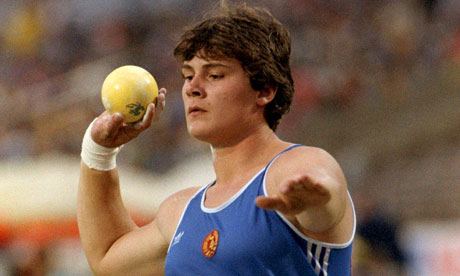
Athlete Heidi Krieger of the former German Democratic Republic

East German shotputter Heidi Krieger underwent gender reassignment surgery and changed her name to Andreas. Photograph: Joerg Schmitt/ Getty Images

For more than a year, officials in Beijing have been designing a special laboratory to determine the sex of any athletes taking part in this year's Olympic games. "Suspected athletes will be evaluated from their external appearances by experts and undergo blood tests to examine their sex hormones, genes and chromosomes for sex determination," says Professor Tian Qinjie. The tests will not be conducted on every female athlete, but will be required if serious doubts have been raised about an individual competitor - invariably one competing in the women's events. "The aim is to protect fairness at the games while also protecting the rights of people with abnormal sexual development," he says.

The International Olympic Committee (IOC) introduced sex testing in 1968 at the Olympic games in Mexico City, after the masculine appearance of some competitors, many pumped up by anabolic steroids, had started to raise questions about the gender of athletes in female events. Unsurprisingly, gender-determination tests were seen as degrading, with female competitors having to submit to humiliating and invasive physical examinations by a series of doctors. Later, the IOC decided to use a supposedly more sophisticated genetic test, based on chromosomes. Women usually have two X chromosomes; men an X and a Y chromosome. So, according to the rules of the test, only those athletes with two X chromosomes could be classed as women. However, many geneticists criticised the tests, saying that sex is not as simple as X and Y chromosomes and is not always simple to ascertain.

It is thought that around one in 1,000 babies are born with an "intersex" condition, the general term for people with chromosomal abnormalities. It may be physically obvious from birth - babies may have ambiguous reproductive organs, for instance - or it may remain unknown to people all their lives. At the Atlanta games in 1996, eight female athletes failed sex tests but were all cleared on appeal; seven were found to have an "intersex" condition. As a result, by the time of the Sydney games in 2000, the IOC had abolished universal sex testing but, as will happen in Beijing, some women still had to prove they really were women.

Transsexuals, who have had a sex change from male to female, can compete in women's events in the Olympics, as long they wait two years after the operation.

The following are some of the more famous instances when female athletes were caught in the gender trap.

Santhi Soundarajan

One of the most tragic recent cases is yet to reach a conclusion. Soundarajan, a 27-year-old Indian athlete, has had to endure public humiliation after she was stripped of her silver medal for the 800m at the Asian games in 2006. Soundarajan, who has lived her entire life as a woman, failed a gender test, which usually includes examinations by a gynaecologist, endocrinologist, psychologist and a genetic expert. The precise results of the test have not been made public, but it has been reported that the likely cause is a condition called Androgen insensitivity syndrome, where a person has the physical characteristics of a woman but whose genetic make-up includes a male chromosome. The Canadian cyclist Kristen Worley, who has undergone sex reassignment surgery, is one of a number of people who are calling for Soundarajan's medal to be reinstated. "It should never have been handled in such a gross manner, amounting to public humiliation because of their ignorance of her condition," Worley has said. "The Olympic movement has been dealing with intersex people since the 1930s. You'd think they would have got the hang of it by now." The humiliation and prospect that her career may be over has taken its toll on Soundarajan. In September, Indian newspapers reported that she had survived a suicide attempt.

Edinanci Silva

Born with both male and female sex organs, the Brazilian judo player had surgery in the mid-90s so that she could live and compete as a woman. According to the IOC, this made her eligible to participate in the games and she competed in Atlanta 1996, Sydney 2000 and Athens in 2004. In Sydney, she beat the Australian judoka Natalie Jenkins, who raised the issue of Silva's gender in a press conference, constantly referring to her as "he". "I have never fought that one before. My plan was not to grip with her, she's - he's - very strong," she said. Silva gave a mouth swab to officials, which proved she was female.

Dora Ratjen

In the 1936 Olympic games in Berlin, Adolf Hitler wanted to show the world the supremacy of the Aryan race - and he needed German athletes to win. Ratjen, notable for her deep voice and her refusal to share the shower room with the other female athletes, was Germany's entry for the women's high jump. She came fourth. Britain's competitor, Dorothy Tyler, who won a silver medal, remembers her. "I had competed against Dora and I knew she was a man," she says. "You could tell by the voice and the build. But 'she' was far from the only athlete. You could tell because they would always go into the toilet to get changed. We'd go and stand on the seat of the next-door cubicle or look under the door to see if we could catch them." Tyler held the world record for the high jump, but when officials wrote to her telling her that Ratjen had broken it, she wrote back. "I said: 'She's not a woman, she's a man,'" she says. "They did some research and found 'her' serving as a waiter called Hermann, so I got my world record back again." Dora, who had been born Hermann Ratjen, had in fact been a member of the Hitler Youth and said that the Nazis had forced him to enter as a woman.

Stella Walsh

At one point, Walsh, a Polish-American sprinter, was the fastest woman in the world. Born Stanislawa Walasiewicz in Poland in 1911, she grew up in the United States, although she represented her country of birth at the 1932 and 1936 Olympics, winning gold and silver medals respectively for the 100m sprint. During her long career, she set more than 100 national and world records and was inducted into the American Track and Field Hall of Fame in 1975. She lived her entire life as a woman, and even had a short-lived marriage to an American man. In 1980, Walsh was killed by mistake during an armed robbery at a shopping mall in Cleveland, Ohio. The postmortem revealed she had male genitalia, although this did not prove that she was a man as she was also found to have both male and female chromosomes, a genetic condition known as mosaicism.

Heidi Krieger

It is believed that as many as 10,000 East German athletes were caught up in a nightmarish state-sponsored attempt to build a race of superhuman communist sports heroes and force-fed cocktails of steroids and other performance-enhancing drugs. One of them was Heidi Krieger, a shot putter. When she was 16, her coach put her on steroids and contraceptive pills and she gained weight, built muscle and started to develop body hair. By 1986, aged 20, she was European champion. Her overdeveloped physique had put a huge amount of pressure on her frame, causing medical problems, while the drugs had caused mood swings, depression and resulted in at least one suicide attempt. By the mid-90s, Krieger underwent gender reassignment surgery and changed her name to Andreas. She had already been confused about her gender, but felt that the drugs had pushed her over the edge. "I didn't have control," Krieger told the New York Times four years ago. "I couldn't find out for myself which sex I wanted to be." At the trial in 2000 of Manfred Ewald, the East German sports official and architect of the doping regime, Krieger said "They just used me like a machine".

Original here