Followers

Wednesday, June 25, 2008

Six Crazy Concept Bikes You'll Never Ride

There's something about the bike, along with the chair, that draws designers. Despite being an almost perfect design already, the reworkings of the humble bicycle seem almost endless. Some are genuine improvements, such as the change from pedals fixed to the front wheel (Penny Farthing) to a rod or chain driving the rear wheel, and others are less so (low-riders, anyone?)

You wouldn't think that much more could be done to the basic diamond-framed, two-wheeled approach, but those designers can' stop fiddling. Here are some of the fruits of their labors.

Above: A bike with square wheels may look impractical, but it would actually be ridable -- on a highway that is surfaced with a series of inverted catenaries.

Photo: vrogy/Flickr


Pilen Concept
This one makes it into the list because it looks so cool. Based on 1930s Le Mans racing bikes, the Pilen Concept is designed by Eric Therner for Swedish company Pilen Bikes. Is might look retro, but hidden behind the styling is a lot of high-tech gear. LED lights are built in to the frame and the saddle is in two parts for independent shock absorption.

Oddly, despite having two brake levers, the Pilen doesn't seem to have a front brake. And the nonadjustable seat height could be a problem, too. But who cares when it looks this good?

Pilen Concept product page [Addi via Design Boom]

Cube Urban Street Concept
This bike, despite its looks, is a folder, squishing down to a backpack-sized collection of carbon fiber rods and tubes. You'll still need to find somewhere to put the wheels, but once that's done, you have another pretty theft-proof design. And it's just as well. Carrying a lock would probably treble the weight of the bike.

Cube's Collapsible Carbon Concept Cycle [Gadget Lab]


Cardboard Bike

The idea behind design student Phil Bridge's concept is that it is theft-proof: Nobody would steal a cardboard bike. And if they do, it'll only cost $30 to buy a new one. This isn't any old cardboard -- it's hexacomb cardboard, a tough material used in the packing industry which can be foil-faced for waterproofing.

Bridge says that the bike should last for around six months in normal use, and the non-card parts can simply be reused on the next one. We do wonder, though, how the high-stress components will do. I've been through plenty of cranks in the past, for example, and those were made of metal.

Design Student Produces $30 Cardboard Bike [Quickrelease via Bicycle Design]

Puma Bike
The Puma isn't a concept bike, since you can actually buy one, but it's definitely in the spirit of the weird and wonderful. It's Puma Bike is a single-geared bike with dual-disk brakes.

The central conceit is the cable replacing one section of the frame (the down tube), which renders it pretty much theft-proof. The idea is this: You remove the cable and use it to lock the (now-folded) bike. If a thief cuts the cable, he can't ride off on the bike. Simple and almost worthy of Alexander the Great in it's ingenuity (Alex was the Gordian knot guy).

While we've covered the Puma bike before (in its Glow-Rider guise) we've never tested one, so we can't confirm our fear that that cable-strung frame will be a little mushy and wobbly to ride. €1100 ($1700).

Puma Bike product page [Puma]


The Ride
Ellsworth Bicycle's "The Ride" is another bike you can actually purchase, if you've got the dough; but it deserves a place in this lineup for its crazy transmission. Instead of using a fixed number gears, The Ride's "continuously variable planetary drive" offers an infinitely variable drive ratio. As you twist a dial on the handlebar, it changes the angle between two steel plates in the hub, adjusting the torque. The design was first envisioned by Leonardo da Vinci in the 1490s, and it can be yours for a mere $3,000.

Original here

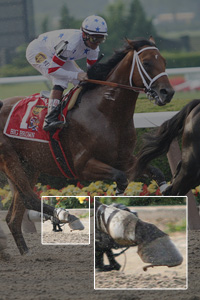
Big Brown photo reveals loose shoe early in Belmont Stakes

A photo taken during the early stages of the Belmont Stakes has revealed Big Brown was running with a loose shoe as the Kentucky Derby and Preakness winner attempted to become the first Triple Crown winner since 1979.

Michael Iavarone, a co-president of International Equine Acquisitions Holdings -- Big Brown's stable -- told Newsday that freelance photographer Russ Melton e-mailed him two close-up shots, which he opened late Saturday night.

Big Brown

Copyright Russ Melton

Big Brown's dislodged shoe, shown about 200 yards into the Belmont, may have "been like trying to run with a wobbly cleat."

The photos show a dislodged shoe on the horse's right hind hoof about 200 yards into the Belmont.

There was no evidence of injury to the hoof after the race, but Iavarone didn't think it could have been comfortable for the horse, who was wearing an acrylic patch on his left front hoof to compensate for a painful quarter crack.

"The picture shocked me," Iavarone said, according to the report. "When the shoe spread, a nail could have been pinching him. Or he could have been stepping on a hot nail, which would have been worse. I'm guessing the nail went back in but not in the same spot. Or it could have been a loose shoe, which would be like trying to run with a wobbly cleat."

"Any of those things would be significant for a horse running a mile and a half. The [deep] track was my original explanation. But now I'm thinking the shoe was dislodged during the race and incorrectly reset while he was running."

In an interview last week with the Thoroughbred Times, Greg Bennett, the primary veterinarian for Rick Dutrow, Big Brown's trainer, confirmed the horse had raced with a loose shoe but minimized the impact it might have had on the Belmont performance.

The bay colt was eased up by jockey Kent Desormeaux in the stretch, ending up last, beaten by eight other horses. Later physical examinations of Big Brown by Dutrow discovered nothing out of the ordinary. Blood tests also revealed nothing abnormal.

"It didn't seem to be any soundness issues with the horse," Bennett said, according to the Thoroughbred Times. "He did loosen [the right] hind shoe, but I don't know how much of a factor that was."

But Bennett said in the Newsday report the loose shoe could help explain Big Brown's abrupt fall from grace.

"When a shoe comes off, it does throw a horse out of balance, but it depends how traumatically it happens and at what stage of the race," Bennett told the paper. "A couple nails can loosen up, which can cause a lot of problems and affect a horse's performance.

Big Brown's stable will transition to a drug-free operation by the end of the year, according to IEAH co-president Michael Iavarone.

"I'm not sure how much of an issue it was with Big Brown. Sometimes horses feel it after the race and are sore, but I'm not aware of that with Big Brown."

Meanwhile, Iavarone said Monday the 50-plus horses owned by his stable will be drug free by the end of the year. That includes steroids and all other legal racing medications except for Lasix.

Iavarone said last week's Congressional hearing in which owners, veterinarians and industry officials expressed a strong desire to rid the sport of steroids led to the decision.

"You see that people that are influential in the game all want it," Iavarone told The Associated Press. "Hopefully we're the first of many [owners] to take the step, but you've got to show you really want it."

Dutrow created a stir before the Belmont when he told reporters he decided against giving the horse his monthly dose of stanozolol, a legal steroid sometimes sold under the brand name Winstrol. Some critics speculated Big Brown was suffering from steroid withdrawal during the race, a notion Iavarone dismisses.

U.S. Rep. Ed Whitfield -- the ranking Republican on the House Subcommittee on Commerce, Trade, and Consumer Protection -- called the move a good sign, but doesn't expect to see other owners lining up behind IEAH.

"I'm confident there's not going to be a mass stampede by owners," Whitfield told the AP. "There are owners in some states who fear [by not taking the drugs] they would be less competitive."

Whether other owners come forward and take a similar stance might not matter. The National Thoroughbred Racing Association and the Racing Medication and Testing Consortium are pushing the 38 racing states to adopt a model rule that would ban all but four steroids considered therapeutic in nature.

I applaud anybody who can see the writing on the wall.

-- California Horse Racing Board chairman Robert Shapiro, on drug-free stables

Under the model rule, which could be in place in each of the states by the end of the year, horses that are administered one of the four approved steroids -- including stanozolol -- would be prohibited from racing for 30 days. Once they return to the track, they must test under the allowable threshold for the drug or the trainer and owner would be subject to penalties and fines.

"If they're not going to do it properly, it's going to be imposed upon them," said California Horse Racing Board chairman Robert Shapiro. "I applaud anybody who can see the writing on the wall."

The writing may not be enough. Whitfield isn't convinced the model rule is strong enough, citing the complicated rule-making process in each of the states and the inability to adopt uniform penalties.

"It sounds good to say X state has adopted a uniform rule, but when you look closer you see that they're not really consistent in any way," said Whitfield, who said the government is considering several options, including creating a national body to oversee the sport.

IEAH's position goes far beyond the model rule. When Big Brown heads to the starting gate for the $5 million Breeders' Cup Classic in Santa Anita in October, he'll be clean, or else.

"We're willing to forgo everything," Iavarone said, according to the AP. "If we win the Breeders' Cup and test for anything positive, even if it's legal, we're going to give up the purse."

A loss on the track would pale in comparison to the loss in the breeding shed.

IEAH sold Big Brown's breeding rights to Three Chimneys Farm in Midway, Ky., for a reported $50 million. If he struggles in the summer and fall -- his next race is the Haskell Invitational at Monmouth Park in August -- his stud fee will plummet and the stable's reputation could tumble.

It's a risk the man who grew up hopping the fence at Roosevelt Park in New York to watch the races is willing to take.

"We're trying to take a forward step to regain the public's confidence," Iavarone said. "It comes down to the public in this game. If the public doesn't show up, if the public doesn't bet on horse racing, they're going to stop betting. Is it the end-all, cure-all? I think it's a step in the right direction. I think if owners just agree to play the game the right way, this can only help."

Information from The Associated Press was used in this report.

Original here

Gang robbed football legend Pele

By Gary Duffy
BBC News, Sao Paulo

Pele (file photo)
Pele is regarded as possibly the world's greatest player

Former Brazilian football star Pele has been robbed by an armed gang while on his way to his seaside home.

As many as 10 people were reported to have been involved in the robbery, but Pele was unhurt in the incident.

He was on his way from the city of Sao Paulo to a house he owns on the coast when the robbery happened at the entrance of a tunnel.

The robbery took place earlier this month, but details have only just emerged.

Police say there is frequent traffic congestion in the area, and that gangs from a nearby favela (shanty town) often take advantage of this to stage robberies.

Robberies common

According to the newspaper Estado de Sao Paulo, Pele's car was surrounded by 10 armed men who took his gold necklace, a mobile phone and a watch.

Pele was in the passenger seat of his car. According to his spokesman, when the gang recognised the former player they gave the driver back some items they had taken from him.

The former Brazilian football star was not so lucky, as the gang then decided to flee on foot with his valuables.

Pele, who is said to have remained calm during the robbery, apparently believed the men were high on drugs.

The local police say they were not informed about the incident.

Robberies of cars stopped at traffic lights or in congestion are not uncommon in Brazil, and many wealthy families have resorted to buying bullet-proof cars as a form of protection.

Original here