Followers

Monday, October 6, 2008

Ancient Chinese sport helps modern breast cancer survivors

By Judy Fortin
CNN Medical Correspondent
Decrease font Decrease font
Enlarge font Enlarge font

PEACHTREE CITY, Georgia (CNN) -- The scene looked like a flashback to ancient China.
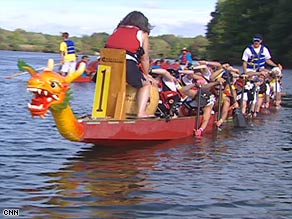
The Steel Magnolias is one of about two dozen U.S. dragon boat teams with breast cancer survivors.

The Steel Magnolias is one of about two dozen U.S. dragon boat teams with breast cancer survivors.

Click to view previous image
1 of 2
Click to view next image

Three boats with fierce dragon heads at the helm cut through the water. Drummers kept time as 20 paddlers in each craft vigorously moved their boats toward the finish line.

The sport dates back thousands of years, but some of these warriors are modern-day breast cancer survivors racing in a dragon boat festival on Lake Peachtree south of Atlanta, Georgia.

"It's like a floating support group," proclaimed Jill Binkley, a physical therapist and two-time breast cancer survivor.

Binkley, 51, director of Turning Point Women's Healthcare in Alpharetta, Georgia, said the strenuous paddling motion needed to move the 40-foot boat through the water helps breast cancer patients heal.

"It's increasing our range of motion, decreasing our pain that we have after breast cancer surgery and increasing our strength," Binkley said.

"It's reaching, it's digging deep, and it's pulling hard," said Beverly Booth, captain of the Dragon Boat Atlanta team, nicknamed Steel Magnolias.

Booth, 58, an assistant project manager for a construction company, was treated for stage 1 breast cancer in 1999. Her treatment included a lumpectomy followed by chemotherapy and radiation.

Booth started the Atlanta-based team four years ago after learning about the sport from her cousin.

She estimated that there are two dozen dragon boat teams in the United States that include breast cancer survivors.
Booth said regular practices and contests forced her to get out and exercise.

"I've never been a runner, so I can't say I've had that runner's high," Booth said, "but it is exhilarating to paddle in the water."

Booth said that she has no physical limitations that would hinder her movement but that several members of her team have trouble lifting their arms after treatment and can paddle only on one side of the boat.

Binkley dismissed as inaccurate old myths that women shouldn't exercise after breast cancer treatment.

"We know that, in fact, exercise is not only safe for women with breast cancer, but actually we now use it as a treatment for women with lymphedema," Binkley added.

Lymphedema is chronic and progressive swelling that may occur in the arms of breast cancer patients after lymph-node surgery and radiation.

She cautioned women to check with a doctor before starting any exercise regimen during treatment.

Binkley asserted that injury, infection and weight gain may trigger swelling, but research has shown that exercise does not have a negative effect.

A 2005 Harvard University study in the Journal of the American Medical Association found that "physical activity after breast cancer diagnosis may reduce the risk of death from the disease."

A workout doesn't have to be as strenuous as dragon boating; adding any aerobic exercise is helpful, Binkley said. "It could be as little as walking four to five times a week for half an hour," she said.

Vera Berry, another member of the Steel Magnolias, wanted to stay in shape after having a lumpectomy two years ago.

Berry, 54, is an Air Force master sergeant from Fort Payne, Alabama. She drove six hours round trip in order to participate in the recent race.

She said it's worth the time and sacrifice. "Once we hit the water, it's like we're flying. It's like nothing I've ever done before," Berry said.

advertisement

She also pointed to the emotional benefits of exercising alongside other breast cancer survivors. "If you have any questions or worries, there is always someone who has been there."

Booth summed it up. "People have been there with me. They know what I've been through. I know what they've been through. If you want to talk about cancer, you can, and if you don't want to talk about cancer, you don't have to."

Original here

Death crash footballer is jailed


Luke McCormick -archive picture
McCormick is said to have driven "like an idiot"

A professional footballer has been jailed for seven years and four months for killing two children in a crash.

Former Plymouth Argyle goalkeeper Luke McCormick, 25, admitted causing the deaths of Arron Peak, 10, and Ben Peak, eight, and driving with excess alcohol.

The brothers, from Partington, Greater Manchester, died in a crash on the M6 in Staffordshire on 7 June.

Stoke Crown Court heard McCormick had driven "like an idiot". The boys' parents said they were scarred forever.

The court also heard McCormick, who was returning from a wedding, had ignored a plea from a friend to stop driving and pull over at services.

We will both carry the emotional scars forever
Philip and Amanda Peak

Friends and relatives of the boys' family jeered McCormick as he arrived at court.

In a victim impact statement the boys' parents, Philip and Amanda Peak, said their lives had been shattered by the accident.

Philip Peak remains in a wheelchair and wears a neckbrace. He suffered spinal and lung injuries in the crash and may need further surgery.

Mr and Mrs Peak said they were disappointed McCormick would be eligible for parole in three-and-a-half years' time.

"In court, his barrister spoke of the effect this case has had on Luke. We find this offensive.

"Phil will carry the scars of the incident for life. We will both carry the emotional scars forever," they said.

Advertisement

CCTV of Luke McCormick's car before the crash

The court heard that when breathalysed McCormick was found to have 74 micrograms of alcohol in 100 millilitres of breath.

The legal limit is 35 micrograms of alcohol per 100 millilitres of breath.

The brothers and their father Philip Peak, 37, were in a Toyota Previa with friends, travelling to Silverstone racetrack, when the crash happened.

Their car was involved in a collision with McCormick's Range Rover at about 0545 BST on the southbound carriageway of the motorway between junctions 15 and 16, near Keele services.

The Peak family
Friends and relatives of the Peak family were at the court

Mr Peak, 37, who was driving, was seriously injured in the crash.

McCormick kept his head bowed and covered his face with his hand as the court heard he had told eyewitnesses at the crash scene: "I am so sorry, I'm sorry. I just fell asleep. I fell asleep, I'm sorry."

Before the accident other motorists noticed him "driving like an idiot" and estimated his speed at around 90mph (144km/h).

In mitigation, John Jones told the court he had been on his way to "sort out his love life," when the crash happened.

'Speed and alcohol'

He had been at a teammate David Norris's wedding in Bolton when he became upset about rumours of his fiancee's alleged infidelity which had been posted on the internet.

He was seen drinking beer and downing shots of sambuca before leaving the reception at 0200 BST. He got two hours sleep before getting up and leaving for Coventry.

The court heard he ignored a telephone plea from his room-mate to stop driving and pull over at services.

McCormick, a former England youth international, had his contract with Championship side Plymouth cancelled by mutual consent a month after the crash.

He was disqualified from driving for four years for causing death by dangerous driving.

Sgt Steve Robinson of the Central Motorway Police Group said McCormick had nearly collided with several people before the crash took place.

"I am shocked at the speed and the alcohol," he said.

"If he had only stopped, this tragedy could have been avoided."

Original here

Butch Cassidy Behind the Wheel

By PETER MCALEVEY

I cannot recall exactly when I first met Paul Newman. It was the late 1960s or early ’70s, and the world had gone car crazy.

Skip to next paragraph
Associated Press

Paul Newman, who died Sept. 26, after winning a 1982 race at Lime Rock in Connecticut.

Henry Ford had tried to buy Ferrari and been rebuffed, then spent millions on the GT program to beat Ferrari at its own game, and won the 24-hour race at LeMans.

Detroit was pushing out thousands of dangerously fast street racers like the Pontiac GTO, the Plymouth GTX and the Dodge Hemis — midsize cars with seven-liter motors originally developed for trucks or Cadillac limousines.

People like Phil Hill and Southern California’s Dan Gurney were beating the Europeans at their own game, Formula One racing.

While growing up in Rockland County, N.Y., about the closest we would ever get to a Grand Prix was climbing the trees around the Watkins Glen racetrack that hosted America’s lone major international race. (We could not afford the $20-plus tickets.)

But closer to home, we had our own little hideaway — a lesser-known but nonetheless beautiful track called Lime Rock Park in northeastern Connecticut.

At just 1.6 miles long and maybe 8 or 10 turns, with no bleachers, it was hardly Formula One material.

Lime Rock, in the bucolic Berkshires, had a family atmosphere. After the races, children were free to mingle with the drivers in the pits. The lucky ones were invited to an after-race party at the big barn that dominated the end of the front straight.

More often than not, that party was hosted by a handsome driver named Paul, who usually rolled out a few kegs of his beloved Budweiser.

Only after watching “Butch Cassidy and the Sundance Kid” a year or two later did I realize that the guy I remembered driving his Triumph TR4 at Lime Rock was Paul Newman, who took on the entire Bolivian army in perhaps the greatest finale of any movie ever made.

When he died on Sept. 26, almost everyone mentioned that he was the co-owner of the top-ranked Newman-Haas IndyCar/CART team that had sponsored Mario Andretti, the Indianapolis 500 and Formula One champion, as well as his CART champion son Michael and other well-known racers, like Paul Tracy.

That was only part of Newman’s story. He was deeply involved in the business of winning races as a car owner, but he never quit driving. He was a national champion who turned professional in the Sports Car Club of America’s Trans-Am series, the oldest professional racing series for hot cars like Mustangs, Camaros, Nissans and Porsches in the United States.

In the mid-’80s, I ran into him at the Long Beach Grand Prix, in which his Newman-Haas team was competing. He was driving his de facto factory Nissan in the Trans-Am race that opened the weekend’s racing.

It was not one of his better outings — in those days, the Trans-Am had what was called Fast Five qualifying, a variant on the Indy practice of allowing only the fastest drivers on the first day on the pole, with everyone else competing for slots behind them. Newman’s Nissan had some problem and, despite being one of the fastest cars on the track, was relegated to no better than the sixth spot on the grid.

That piqued Newman’s pride, and as the pack roared down Long Beach’s Shoreline Drive for the rolling start at better than 150 miles per hour, Newman decided he would take his rightful space in the front by squeezing by the lesser Mustangs and Camaros before the first turn.

The result was predictable. Like many a racer before him, he was out of control going into the first turn and could not brake in time. The resulting crash took out many of the cars ahead of him, including a few of the championship leaders. Despite the havoc, he never backed down. And once the wreckage was cleared and the race restarted, he walked down the pit road apologizing to each team whose chance he had upset.

What was anyone going to say to Butch Cassidy?

Several years later, as the vice president for production at Walt Disney Pictures, I was assigned to oversee what we called the Paul Newman account. Disney had just made the hit movie “Color of Money” with Paul and Tom Cruise, and had entered into an overall deal with him.

My job was to interact with Paul, find projects for him to star in or otherwise make sure he felt loved. It was not as easy as it sounded. As his lawyer pointed out to me one day, “It’ll have to be a hell of a project to get him away from his addiction to automobiles.”

It was true, and yet another reason I will always remember him as a young driver at Lime Rock, his face covered with the grime of hours and hours of racing, hoisting a cold one and saluting us all for a great day — even if we were too young to drink.

Peter McAlevey is a film producer and a former correspondent for Newsweek.

Original here