Followers

Saturday, December 13, 2008

It's not over until the fat boy spins

By Nick Bryant
BBC News Sydney correspondent

Shane Warne
Shane Warne did not give his permission for the musical to be released

We have seen Shane Warne the scourge of English batsmen. We have seen Shane Warne the victim of the British tabloids.

Now we have Shane Warne: the Musical - though it could easily have been entitled Shane Warne and his Amazing Technicolour Life.

This most operatic of cricketing careers has been the inspiration for 24 songs, chronicling his on - and off - the field exploits.

What An SMS I'm In makes musical reference to the stray text messages that sometimes landed him in hot water with his former wife, Simone.

Take The Pill deals with another unhappy episode in his life: his use of a banned diuretic which led to a one-year suspension from cricket and blocked him from playing in the 2003 World Cup.

In Melbourne, I was given a sneak preview of two of the songs, and found both hilarious.

The first chronicled how a chubby suburban schoolboy became a slightly less chubby international sportsman. It begins with the sound off-stage of his adoring mother, Brigitte, leaving a message on the answer machine of his coach or spin doctor, the former Australian spinner, Terry Jenner.

"He's jogging," she says, with genuine astonishment. "He's actually jogging."

Hush little Shane. When you grow up you are gong to destroy the English. Do you hear me? DESTROY THE POMS!
Shane Warne: The Musical
The lights then go up on our corpulent hero, resplendent in a shell-suit and sporting an extravagant bleach-blonde mullet. He is pounding the pavements in an attempt to get fit, much to the shock of a group of friends.

"Look, look at young Shane, jogging whether its sunshine, hail or rain," sings one, in Wagnerian style. "Now he's doing crunches," sings another friend. "Wow, look at him doing crunches," echoes the chorus.

As the song continues, we get a flashback, with Mrs Warne walking behind cradling baby Shane in her arms. "Hush little Shane," she whispers. "When you grow up you are gong to destroy the English," her voice rising in volume with each word. "Do you hear me? DESTROY THE POMS!"

Pucker accent

Then we see two bowler-hatted City types enter from stage left. "Look at that frighteningly blonde man from the colonies," says one in a pucker English accent.

"Does he seriously think he has the mustard to take on the motherland?" the other responds. They collapse into maniacal laughter when one lands the cheap shot: "It's not over until the fat boy spins."

By the end of the song, the shell-suit has come off, replaced with a pristine set of cricket whites. The mullet is cast aside and we see for the first time the trademark shock of peroxide blonde hair.

There are no cheap shots. Our shots are very expensive
Eddie Perfect

The transformation is complete when those golden locks are adorned with the famed Baggy Green, the cap that Australian cricketers wear with such pride. "Warnie Warnie" is spelt out in bright lights. After all, this tonsils-in-cheek stage show is also a musical tribute.

The show's creator, writer, and Warnie look-a-like star is Eddie Perfect, who has been working on it for three years. He describes his subject as the gift that never stops giving. "It's about what you leave out rather than what you put in," he says.

"I did a lot of research and if I'd put in everything we would have had Wagner's Ring and have been here for three nights."

Perfect is an admirer of Shane Warne, and there's reverence in the musical along with all the ridicule. "It's about how someone can be so innately gifted and an incredible performer on the pitch, and have this fraught disastrous life off it. That's what we play with. He's a very human hero," says Perfect. "He's not pretentious. He's very approachable and likeable.

"We spent three years developing this show, and we found very early on was that cheap shots weren't going to cut it. There are no cheap shots. Our shots are very expensive."

The musical is now playing to Warnie's hometown audience in Melbourne. But, like the man it celebrates, it looks destined to dazzle on a much grander stage.

Original here

Uefa to investigate Rooney stamping allegations

Tom Lutz

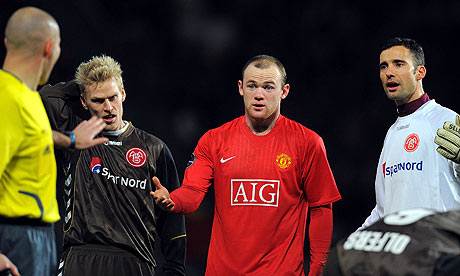
Wayne Rooney and Aalborg players

Wayne Rooney and Aalborg players react after the alleged stamping incident last night. Photograph: Andrew Yates/AFP/Getty Images

Wayne Rooney could miss the next round of the Champions League after Uefa said it would investigate a claim that the striker stamped on Aalborg's Kasper Risgard during last night's match at Old Trafford.

"We are aware of the incident and the disciplinary panel will study the footage and newspaper reports before deciding whether to take action," said a Uefa spokesman today.

Rooney clashed with a number of Aalborg players during the match and he appeared to bring down his studs on Risgard when his opponent was on the floor.

"I don't know what he was thinking but he jumped on my chest," said Risgard after the game. "I don't know why but I think he was a little bit frustrated. But I don't understand it because they were playing good football and the score was 1-1 at the time."

Risgard also added that Rooney had shown contrition after the game. "Anywhere else but this place it would have been a red card," he added. "These challenges happen in football - I have some big marks - but I do think it looks good on television. He did come and apologise to me after the game."

A decision is unlikely to be made today, but if found guilty Rooney would face suspension for part of the knockout stages of the Champions League.

Original here

F1 teams agree on drastic cost cuts

By Andrew Baker

Max Mosley -  FIA agree to swinging cost cutting in Formula One from next season
Less is more: FIA president Max Mosley wanted the cuts in Formula One agreed by teams to go even further Photo: AP

There will be savings on engine costs, a ban on in-season testing outside grand prix weekends and a reduction in staff numbers that will mean bad news for many skilled workers in Britain’s south Midlands, the worldwide centre of motor sport.

Engines will be available to the independent teams from 2010 for less than £4.5 million per team per season, supplied by an independent supplier or a manufacturer backed by guarantees of continuity.

This could mean huge savings for teams such as Williams and Force India, who currently buy their engines from Toyota and Ferrari respectively.

There will be no in-season testing from next year except during a race weekend and during scheduled practice, which could mean extra action for weekend racegoers.

The teams have also agreed that manpower will be reduced by means of a number of measures, including sharing information on tyres and fuel to eliminate the need for “spotters” who scan the activities of other teams for tactical clues.

The FIA estimate that the list of changes for 2009 will save the manufacturer teams approximately 30 per cent of their budgets compared to 2008, with the savings for independent teams even greater.

But this is still a lot less than the drastic cuts that FIA boss Max Mosley wants to see.

The proposals for change are as follows:

From 2009:

* Engine life to be doubled. Each driver will use a maximum of eight engines for a season, plus four for testing (i.e 20 per team).

* Engines to be limited to 18,000rpm.

* Cost of engines to independent teams will be approximately 50 per cent of 2008 prices.

* No wind tunnel testing using models exceeding 60 per cent scale and speeds of 50 metres/sec to be used after 1 January 2009.

* Factory closures for six weeks per year, to accord with local laws.

From 2010:

* The engine from 2010 will continue to be used in 2011 and 2012 (thus no new engine for 2011).

* Subject to confirmation of practicability, the same transmission will be used by all teams.

* The FIA are to compose a standard parts list relating to the chassis. Some parts will be allowed development, other will be required to use inexpensive materials.

* For a race weekend there will be standardised radio and telemetry systems, a ban on tyre warmers, mechanical purging of tyres, and most crucially, a ban on refuelling.

* There will also be a possible reduction in race distance or duration (with a proposal to follow from market research).

* With regards to factory activity there will be further restrictions on aerodynamic research, combined with a full analysis of factory facilities with a view to proposing further restrictions on such facilities.

In the longer term, the FIA and FOTA are to study the possibility of an entirely new power train for 2013 based on energy efficiency.

The rules will be framed to ensure that research and development of such a power train would make a real contribution to energy-efficient road transport.

The FIA believe an enhanced Kinetic Energy Recovery System (KERS) system is likely to be a very significant element of an energy-efficient power train in the future.

In the short term, KERS is part of the 2009 regulations, but is not compulsory, however, from 2010 FOTA is considering proposals for a standard KERS system.

With regard to F1 supremo Bernie Ecclestone’s medal system, market research will be conducted, also into a possible change to qualifying.

Original here